CURATED SELECTION · ORIGINAL ENGLISH LINES
A personal selection from Auguries of Innocence
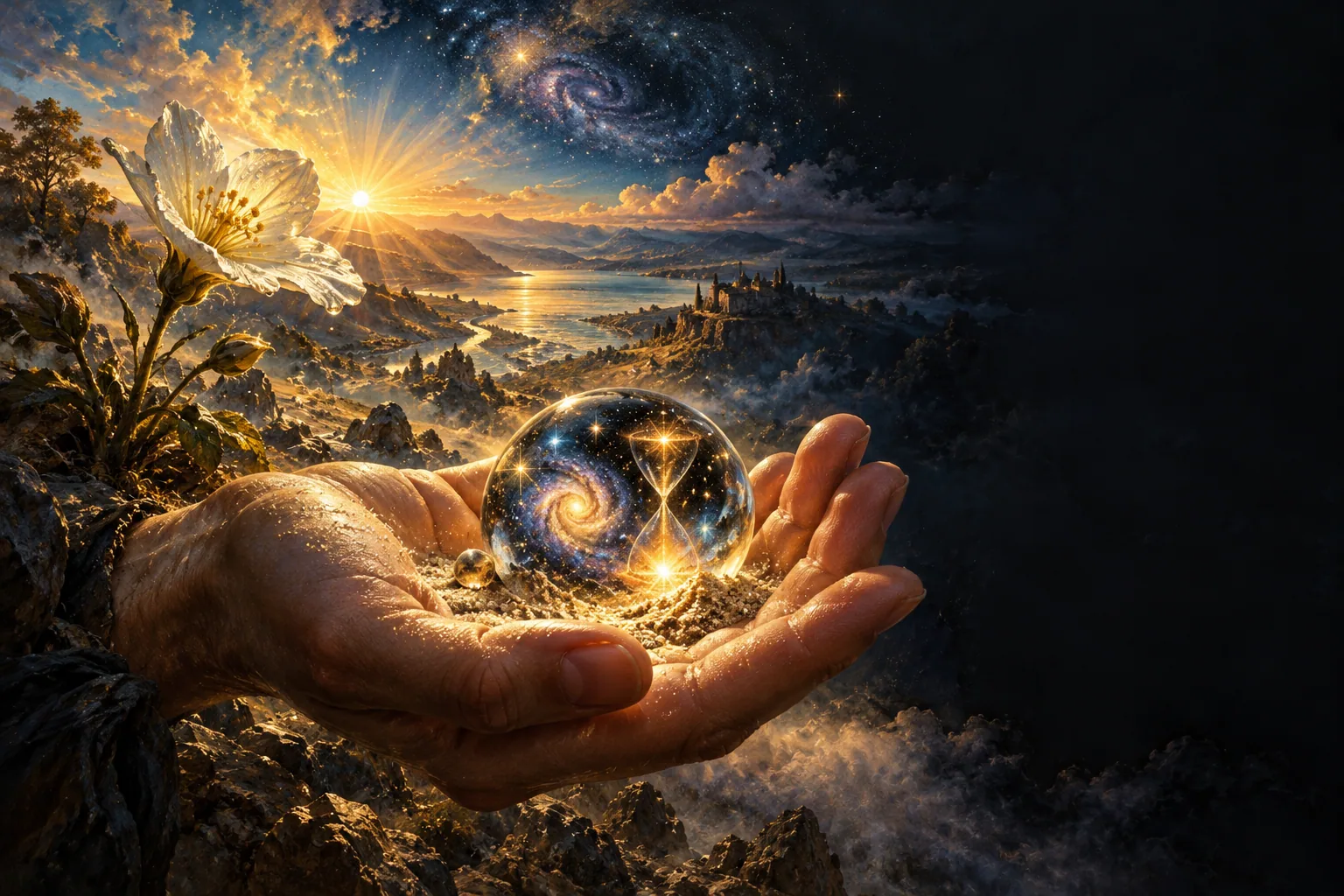
To see a world in a grain of sand
And a heaven in a wild flower,
Hold infinity in the palm of your hand,
And eternity in an hour.
Some to misery are born,
Every morn and every night
Some are born to sweet delight.
Some are born to sweet delight,
Some are born to endless night.
We are led to believe a lie
When we see not thro’ the eye,
Which was born in a night to perish in a night,
When the soul slept in beams of light.
God appears, and God is light,
To those poor souls who dwell in night;
But does a human form display
To those who dwell in realms of day.
This is a personally curated arrangement of verses from different parts of Blake’s poem, not a continuous passage. The poem was first published in 1863.
Three ways of reading
How can infinity inhabit something as small as a grain of sand? Blake opens a space for imagination: the vast reflects itself in the minute, and a single hour may feel like eternity.
The grain and the universe
The gaze moves closer: from a flower to a hand, from a hand to the stars. This is not a physical proof about the cosmos; it is a poetic way of seeing the distance between what we measure and what we feel.
Light and shadow
This personal selection places sweet delight beside endless night. Blake’s complete poem also has a strong ethical current: cruelty to animals, responsibility and the limits of human perception.
In conversation with our story
Within The Five Events, the image becomes a motif of the observer. A single grain need not answer every question — it may simply invite us to look again.
Sometimes the largest world fits in the smallest hand.