THE FINANCIAL MATRIX
A FATHER AND HIS SON
Money, income, spending and the price of personal freedom
A father does not teach his son simply how to earn more. He teaches him how to keep the ability to choose.
An illustrative monthly budget — NOT verified family data
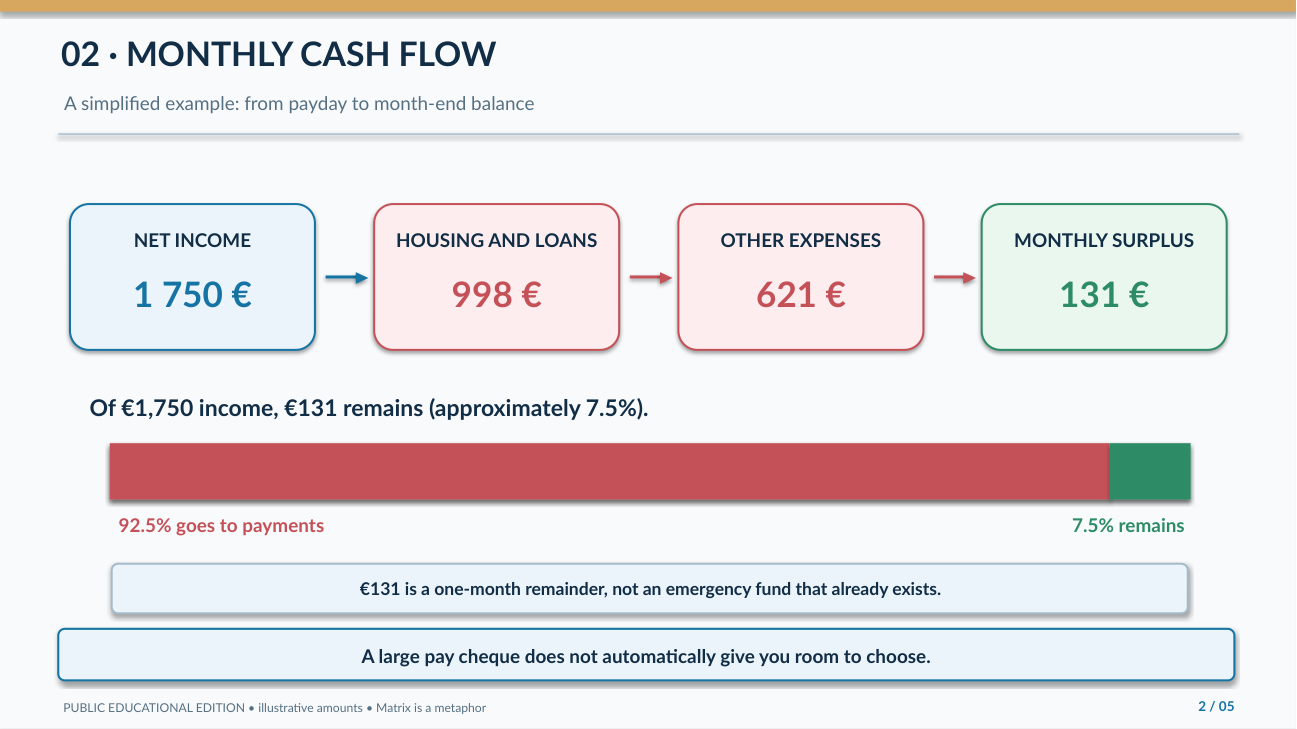
A simplified public teaching example, as used in the original graphic slides: €1,750 net income − €998 housing/debt payment − €621 other spending = €131 left per month. The €998 and €621 categories are deliberately rounded; they are not a proven classification of the handwritten accounts. €131 is a cash-flow remainder, not necessarily an existing emergency fund.
One mortgage instalment, two different economic effects
Numbers from the notes — verified arithmetic, uncertain context
| Item | Arithmetic result | How to read it |
|---|---|---|
| Monthly mortgage illustration | €175.51 + €486.88 = €662.39 | Interest and principal: clear within this example |
| Rounded payment comparison | €662 + €336 = €998 | Rounded values, not necessarily one current loan |
| 16-year recurring-payment example | €19,200 + €30,720 = €49,920 | Nominal total, without inflation or investment returns |
| Handwritten monthly total | €1,619.25 stated / €1,621.75 transcribed | €2.50 discrepancy; not reconciled |
01What is the Financial Matrix?
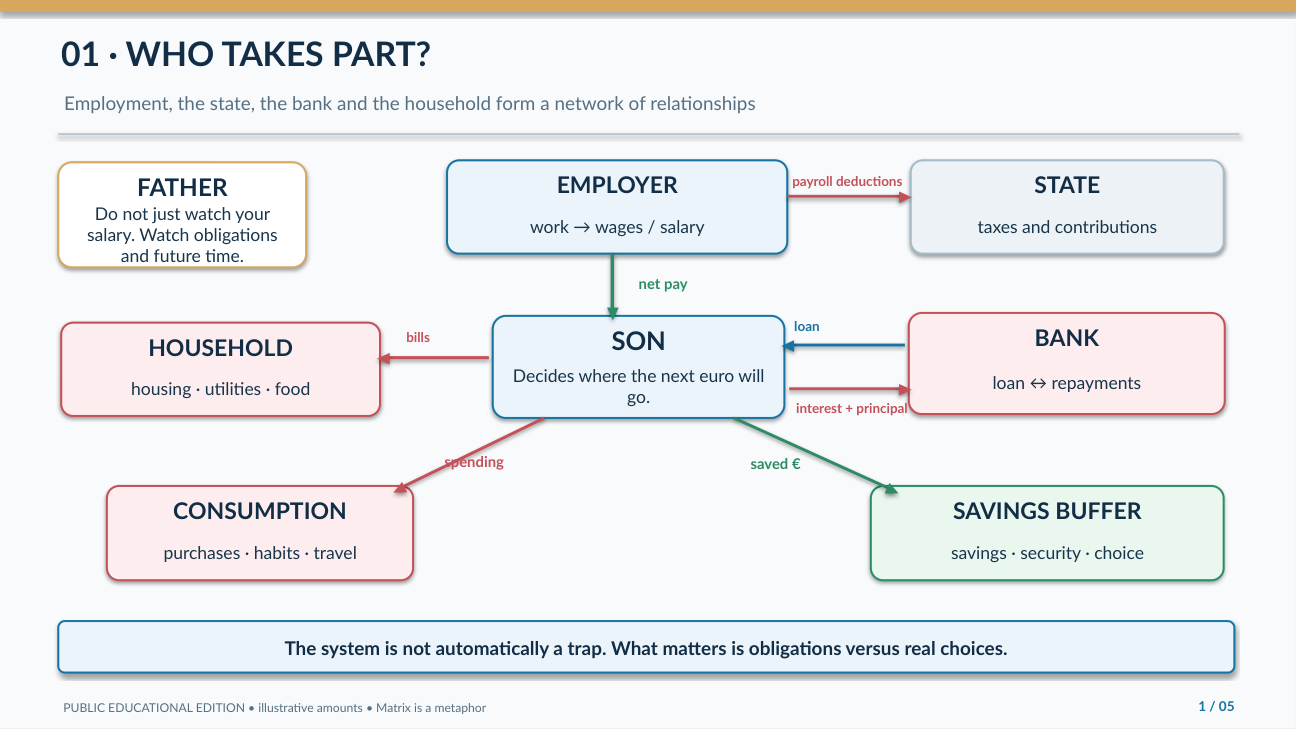
“Matrix” is our metaphor for the network of employment, income, household expenses, banks, debt and consumption. The network itself is not inherently bad: it makes housing, services and cooperation possible. The question is whether the obligations we take on leave us enough room to decide how to live.
A father asks his son a deceptively simple question: How much of your future time have you already promised to recurring payments? A large salary is not the same as freedom. Freedom also requires liquidity, a margin of safety and the ability to say no.
The purpose is to understand incentives and trade-offs rather than blame people who have expensive housing, family responsibilities or limited choices.
02Seven ideas that make the numbers understandable
Income is money received. Distinguish gross from net pay, and steady earnings from unpredictable earnings. Expenses can be essential, contractually committed or discretionary; not all expenses are optional.
Cash flow is money received minus actual cash payments over a period. Assets are things you own, including savings and property; liabilities are what you owe. Net worth equals assets minus liabilities and is not the same as your bank-account balance.
Liquidity means money you can access in time. A flat might have considerable value but will not pay an urgent bill tomorrow. An emergency fund buys time when life changes unexpectedly.
03A mortgage: interest is not principal
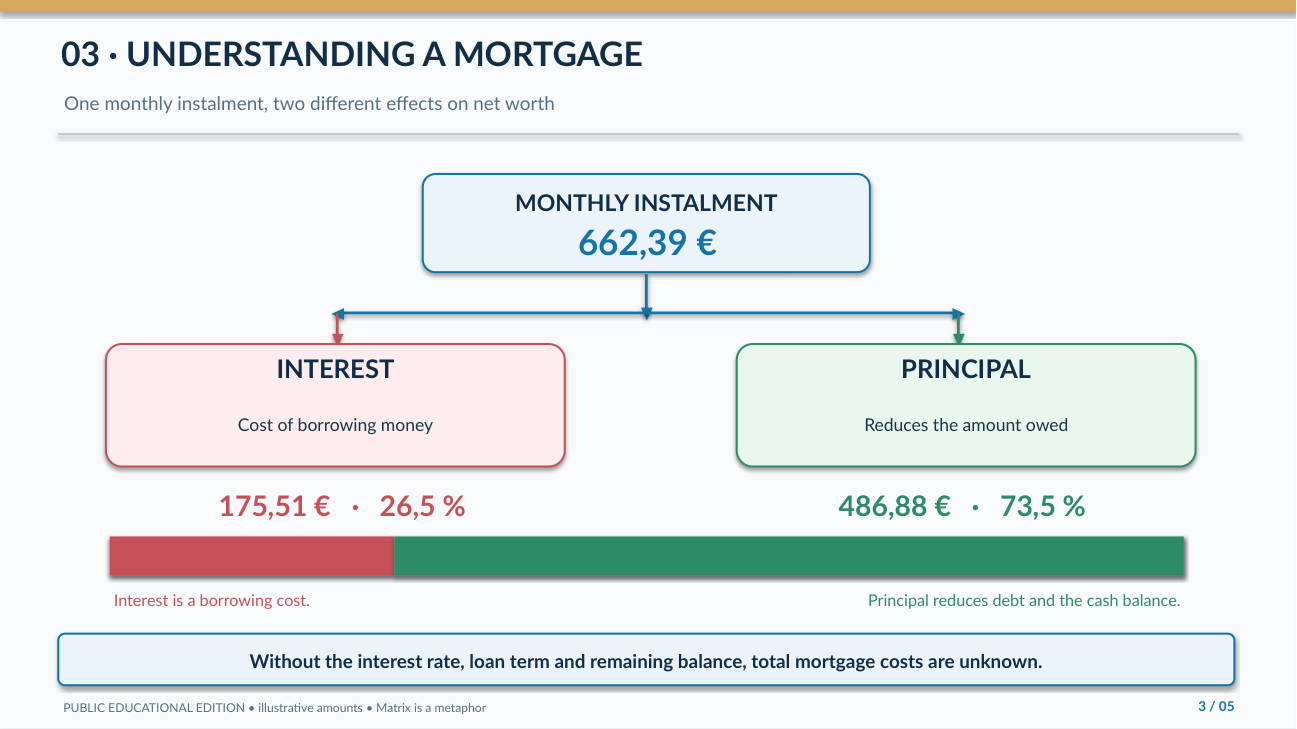
One clearly readable illustration in the notes shows €175.51 interest + €486.88 principal = €662.39 monthly payment. Of that particular payment, approximately 26.5% is interest and 73.5% reduces the debt.
Interest is the price of borrowing; principal repayment reduces the balance owed. Both leave your account, but they have different effects on net worth. Repaying principal can build home equity, assuming the property value is unchanged.
The proportion changes throughout a typical amortising loan. Without the outstanding balance, actual interest rate, remaining term and fees, no one can calculate total lifetime borrowing costs from this note alone.
04Checking the handwritten calculations
€662 + €336 = €998 (rounded); €175.51 + €486.88 = €662.39; €2,400 + €868 = €3,268. Their arithmetic checks out, but the meaning of some amounts is not independently confirmed.
The notes contain a stated monthly total of €1,619.25. Seven approximately transcribed items — €998.50, €260.50, €267.50, €14.50, €17.42, €54.50 and €8.83 — add up to €1,621.75, a difference of €2.50. This is likely a reading or draft-number ambiguity; do not pretend to have reconciled it.
Other amounts, including €621.25, €662, €1,283.25 and €2,793.47, appear in another section but cannot safely be treated as additive obligations without knowing precisely what each represents.
05Small monthly amounts become large commitments
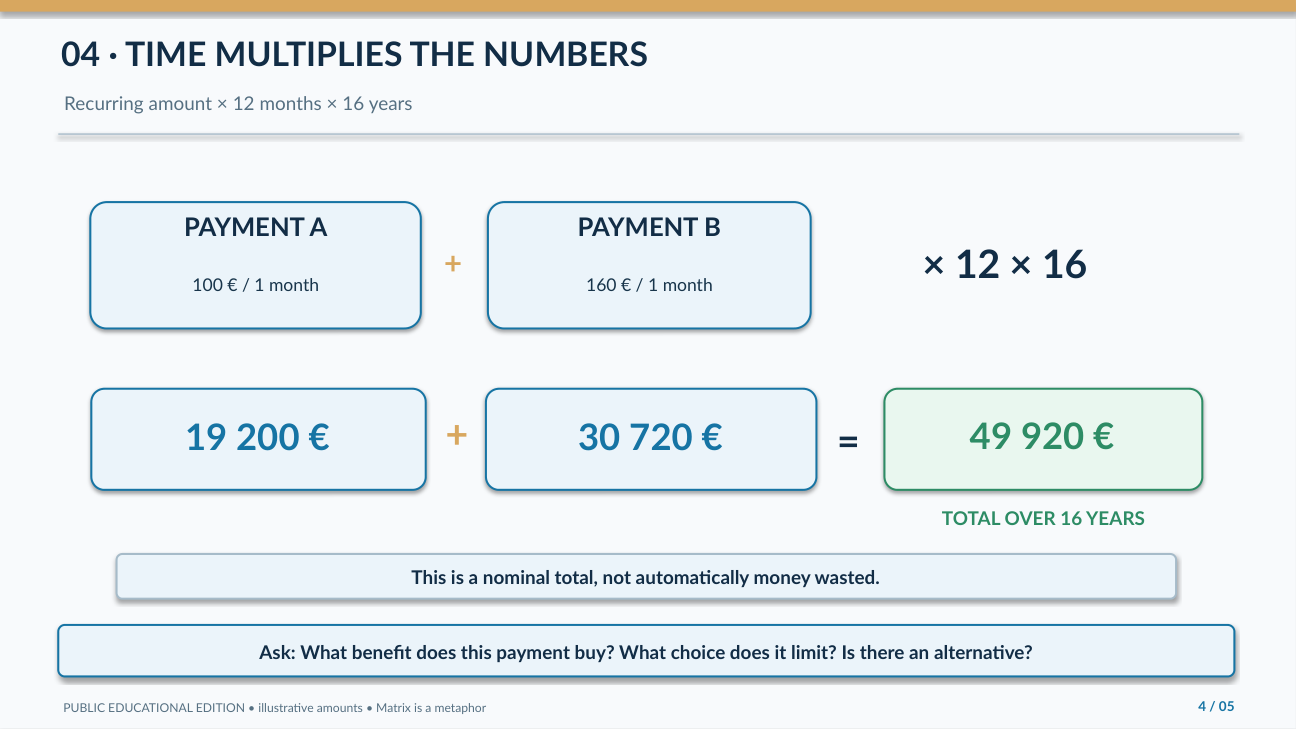
Over 16 years, €100 × 12 × 16 = €19,200 and €160 × 12 × 16 = €30,720. Together, the handwritten long-horizon illustration is €49,920.
This does not prove that the payments were wasted. They could have funded education, healthcare, housing or security. The lesson is to examine the purpose, the benefit and the long-term price of each recurring decision.
These are nominal sums. The exercise intentionally excludes inflation, interest and potential investment returns.
06Five levels of practical financial freedom
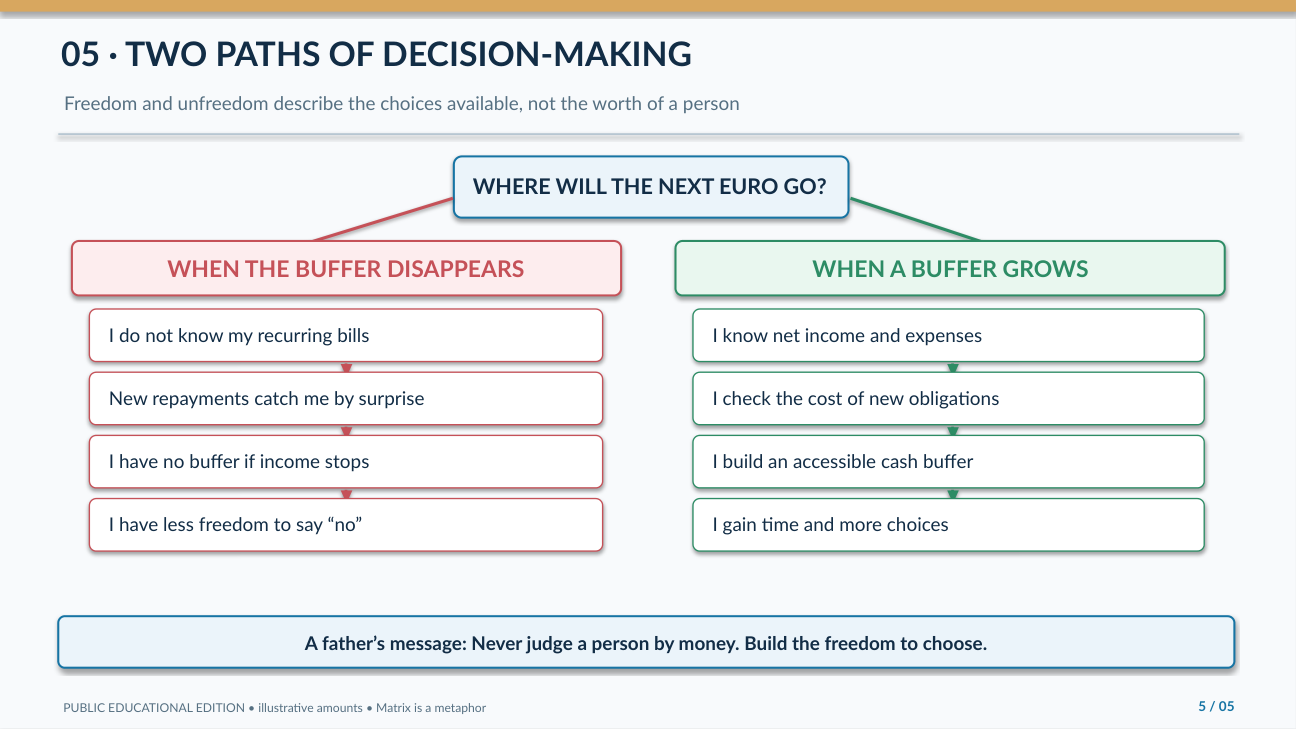
Level 1 — Visibility: I can name my income and every recurring expense. Level 2 — Stability: I meet essential payments without regularly borrowing for them.
Level 3 — Resilience: I have an accessible emergency reserve. Three to six months of essential costs is a common planning reference, not a universal rule.
Level 4 — Flexibility: I can change a job, decline an unfair offer or handle a repair without immediate crisis. Level 5 — Autonomy: an approaching payment does not dictate every major life decision.
07Measure your own Matrix
Fixed-commitment ratio = essential recurring payments ÷ net income × 100%. Savings rate = money deliberately set aside ÷ net income × 100%.
Reserve in months = accessible emergency savings ÷ essential monthly expenses. Debt-payment ratio = monthly loan payments ÷ monthly net income × 100%. Here these are learning metrics, not regulatory or bank underwriting limits.
No single percentage measures human freedom: household size, health, housing market, reliable support and employment conditions all matter.
08Same salary, very different choices
Consider two fictional people who each receive €1,800 net per month. Person A pays €1,650 in essentials and debt payments, leaving €150. Person B pays €1,100, leaving €700.
The difference in monthly room to manoeuvre is €550. That can change how fast each person builds a buffer or whether they can leave a harmful job.
The contrast is not a moral ranking. Location, disability, childcare needs, household obligations and luck can explain much of the difference.
09Blue pill, red pill: a useful metaphor
Blue pill: “My pay increased, so I can afford another obligation.” But I do not review the total cost or ask what I am giving up.
Red pill: “Let me look at the actual numbers, read the agreement and estimate the next ten years.” I choose deliberately rather than being led by an advertised monthly instalment.
Debt can solve real problems; it is not automatically a trap. A consumer loan that brings a short-term benefit can, however, reduce future options. Looking prosperous is not the same as being financially secure.
10Ten things a father wants his son to remember
1. Do not confuse income with wealth. 2. Count essential obligations first. 3. Judge a loan by total costs, not just the monthly payment. 4. Separate interest from principal.
5. Plan for temporary loss of income. 6. Multiply monthly commitments into years. 7. Do not trade your future time merely to impress others.
8. Build the ability to say no. 9. Never measure a person’s worth by money. 10. Let money serve your relationships, values and freedom.
11A practical exercise for the son
Write down every income stream and how reliable it is. Divide all spending into essentials, contracts and optional purchases. For each debt, record the balance, rate, term, fees, insurance and early-repayment conditions.
Calculate how many months you could cover essentials without new income. Choose one regular charge to reconsider. Finally, name three things you would do if the next payment were not pressing on you.
Do the exercise together without judgement. The father provides questions and experience; the son remains the author of his own choices.
12The most important inheritance
Financial freedom is not a fixed sum in a bank. It is the practical capacity to make decisions without every decision being determined by fear of the next bill.
A father’s most valuable gift may not be money. It may be the ability to understand debt, time, priorities and personal dignity.
Money should serve life. Life should not serve money. I LOVE, THEREFORE I AM.
Visual lesson: actors, arrows and decisions
Five editable, easy-to-follow diagrams explain where money comes from, where it goes, how loan instalments work, why recurring expenses add up, and what increases freedom of choice.
Visual lesson in five slides
See individual diagrams